
In the second FlaQuM pillar ‘Co-Creation’, the co-creation roadmap guides hospitals towards future sustainable quality management systems. The model suggests that a manageable number of six drivers and 19 building blocks support the sustainable incorporation of quality into the daily workflow of healthcare professionals (Claessens et al, 2022).
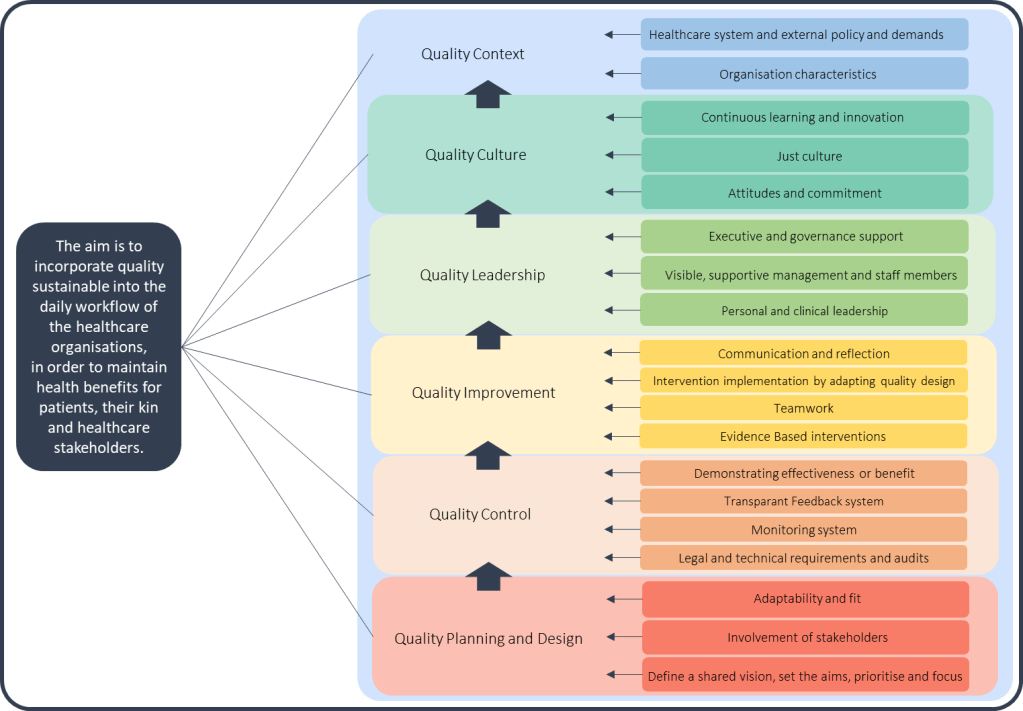
The co-creation roadmap includes six main drivers at the core: (1) Quality Design and Planning, (2) Quality Control, (3) Quality Improvement, (4) Quality Leadership, (5) Quality Culture and (6) Quality Context. The order between the drivers is visualised as a roadmap, starting with the drivers ‘Quality Design and Planning’, ‘Quality Control’ and ‘Quality Improvement’. The next driver is ‘Quality Culture’. To reach this culture throughout the organisation, ‘Quality Leadership’ at every hospital level is needed. The roadmap ends with taking the ‘Quality Context’ of the real-world setting into account. The drivers are feeding into each other and related to 19 building blocks.
Because no assessment tool was available to measure the maturity of the co-creation roadmap implementation in hospitals, a multi-phase approach to develop and validate maturity tools in co-design with 19 hospitals was used. This approach resulted in two validated maturity tools: (1) a maturity matrix with 52 sub-components and (2) a co-creation scan with 19 statements. The comprehensive, but concise maturity tools offer insights into both the current maturity of hospitals’ QMS, i.e. the ‘as-is’ position with uncovered gaps, and the knowledge needed to guide further development towards sustainability, i.e. the desired ‘to-be’ position. By applying a tailored approach in hospitals, these tools allow healthcare leaders at both the hospital and policy level to identify areas on which to focus, to develop a strategic plan, to monitor growth in maturity over time and to support comparison between hospitals’ maturity levels.
 flaqum.org